Should you hold a swing trade through earnings?
By default, no, because an earnings gap can open beyond any stop you set. A stop-loss protects you only while trading is continuous; overnight, price can reopen far past it and your exit fills at the open, not at your level. The defensible choices are to be flat before the report, to cut size to a survivable sliver, or to hold in full knowledge that your real risk is the gap, not the stop.
What a gap actually does to your stop
A stop order becomes a market order when its price trades. Through a session that means slippage of pennies. Through an earnings gap there is no trading between yesterday’s close and today’s open, a stock can close at $100 with your stop at $95 and open at $82. Your "risk" was defined as $5; the market delivered $18. Position sizing built on the stop distance is fiction on report night.
This is not rare-event pedantry. Every earnings season produces double-digit percentage gaps in liquid names, in both directions. The asymmetry is what matters: holding through earns you an ordinary night if you are lucky, and multiples of your planned risk if you are not.
The habit that removes the surprise
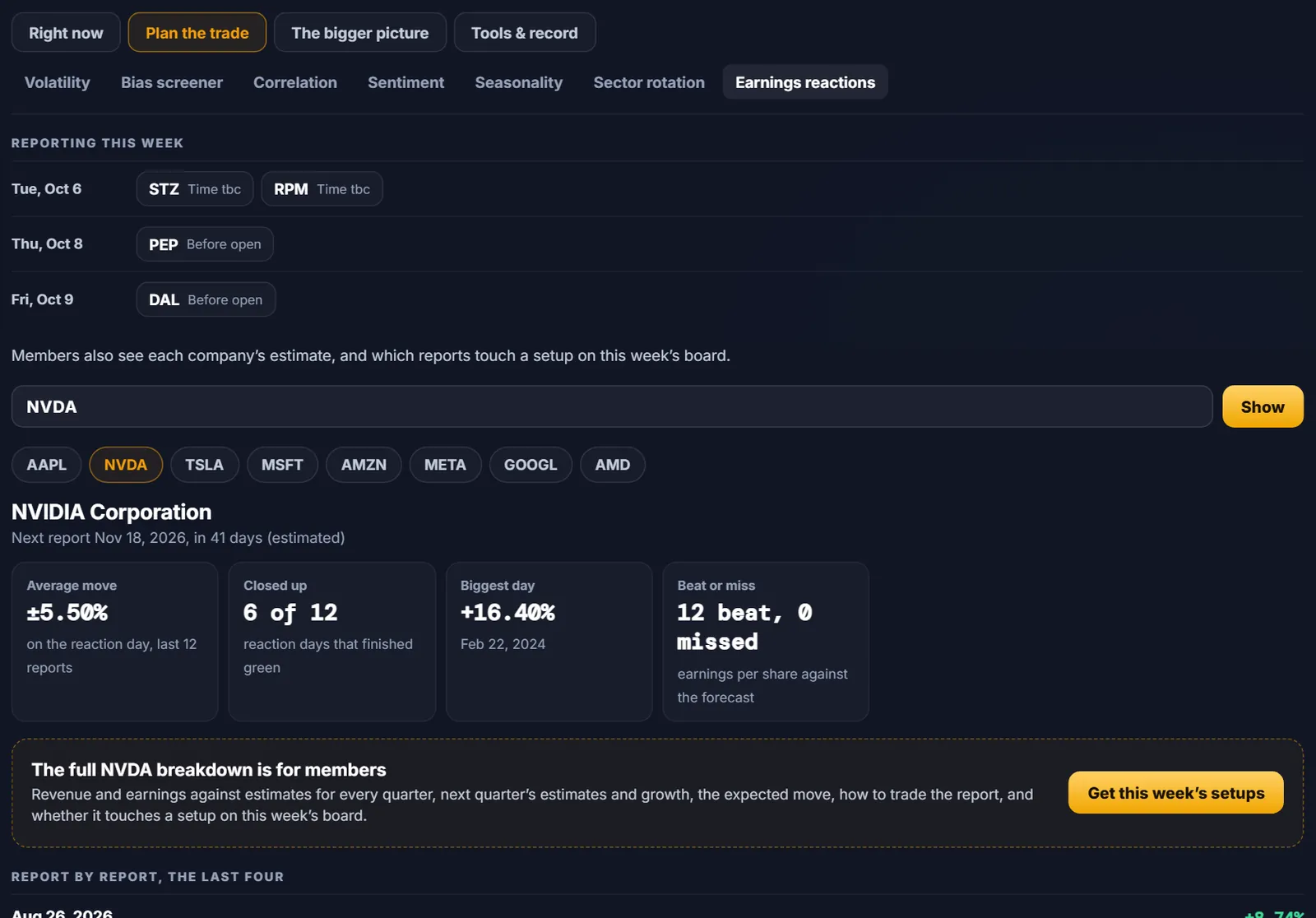
The failure mode is rarely a considered decision to hold, it is not knowing the date. The fix is mechanical: every stock position gets its next report date checked at entry, and re-checked weekly, because dates move. The desk automates exactly this (a warning appears on any stock setup reporting within the horizon, with alert emails seven days and two days out), but a free calendar and discipline achieve the same thing manually.
Seven days out is the decision point, not the night before. That is when you still have room to take profits into strength, tighten scale-out levels, or plan the exit, instead of dumping at Thursday’s close with the crowd of people who also just remembered.
The three honest options
Flat. The clean answer for a swing entry that happens to sit near a report. You can always re-enter after the print with the same rules, the setup either survives the event or it never existed.
Sized down. Cut to a fraction where even a 20% gap costs a tolerable amount of R. This keeps a runner in a strong trend without betting the month on a conference call.
Hold, knowingly. Defensible mainly for long-horizon accumulation positions, the 200-week framework, where the thesis is measured in quarters, size was set with events in mind, and one report is noise. What is never defensible is holding a full-size, stop-defined swing trade through a date you did not know about.
This week’s setups are already mapped
Every Sunday before the open: analysed swing setups across stocks, forex and crypto with the exact entry, stop and target, plus the live dashboard, three letters a week, the TradingView indicator suite and the masterclass library.
Get this week’s setups →111 trades · 54 losers shown · +54.5R see the full record →
FAQ
Do stop-losses work overnight or through gaps?
No. A stop triggers only when its price trades. If a stock gaps past your stop overnight, you are filled near the open price, however far below your level that is. This is the core reason earnings deserve a different rule-set from normal swing risk.
Where do I find reliable earnings dates?
Your broker’s calendar, the company’s investor-relations page, or any major finance portal. Treat dates as provisional until confirmed by the company, they move, which is why a weekly re-check matters more than a one-time lookup.
Does this apply to forex and crypto too?
The gap mechanism is stock-specific (exchanges close; crypto trades continuously, forex nearly so). The equivalent risk in forex is scheduled news like central-bank decisions, same logic, different calendar. Crypto’s version is simply that it never stops trading, so stops work but weekends can move fast.
Can options hedge an earnings hold?
They can cap the gap, at a price, implied volatility is most expensive exactly when you want the protection. It is a legitimate tool for experienced options traders and an expensive comfort blanket for everyone else. Sizing down achieves most of the benefit with none of the complexity.