Trade Desk vs Signal Groups: The Difference That Decides Who Improves
The one-sentence difference: a signal group tells you what to trade; the Trade Desk shows you what to trade and why, the trend structure, the momentum reading and the invalidation level, so every week you get the plan and get measurably better at reading the market yourself.
| Typical signal group | The Trade Desk | |
|---|---|---|
| What you receive | An alert: "buy X at Y" | The full setup: entry, stop, scale-out targets, and the reasoning behind each level |
| When it arrives | Mid-move, whenever the caller acts | Sunday, before the week opens, plus a live trigger watch as levels hit |
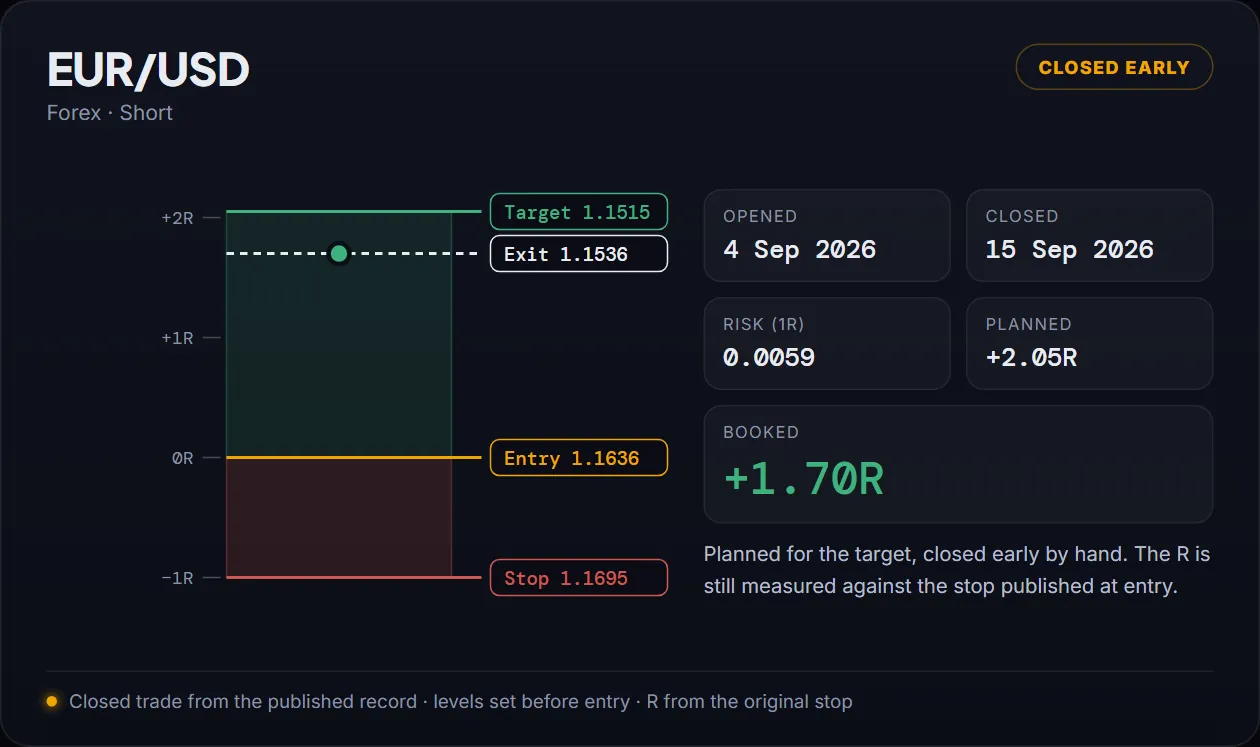
| Can you verify it? | No, you trust the caller | Yes, every setup shows its 3-Gate analysis (Trend · Momentum · Risk) on the chart |
| What happens to your skill | Dependency, when signals stop, you stop | Compounds, 3 teaching letters a week explain the why until you can do it yourself |
| Risk handling | Often no stop given, or moved after the fact | Stop defined before entry, never moved wider, and it's tracked live |
| Typical price | $50–$200+/month | $29/month, or $199/year on the 20% launch offer ($249 after), 95¢ a day monthly, 55¢ a day annual, cancel anytime |
Why copying signals fails even when the signals are good
Two structural problems, independent of the caller's skill. First, latency: by the time an alert reaches you, price has moved, and without the reasoning you can't judge whether the trade is still valid at the worse price. Second, no transfer: a thousand copied trades teach you nothing you can use when the group closes, the caller burns out, or the style stops working. You paid rent; you built no equity.
Analysis-first flips both. Levels published before the open remove the race. Reasoning on every setup means each week compounds into skill, the Trade Desk's 3-Gate System (Trend, Momentum, Risk) is shown on every idea precisely so members eventually stop needing it.
7 red flags of a signal group (screenshot this)
Apply these to any signals service before paying, each one is checkable in minutes:
1. No timestamps. Winners shown as screenshots, never as dated posts published before the move.
2. No stops. Entries without invalidation levels, or stops that quietly widen after entry.
3. Vanishing losers. Losing calls deleted or never mentioned again; the feed is somehow all wins.
4. Income claims. "$500/day", "quit your job", win-rate percentages presented as your expected outcome.
5. Unexplainable method. "Our AI/algorithm says buy" with no reasoning a trader could verify on a chart.
6. Hard exits. DM-to-cancel, long lock-ins, no published refund terms.
7. Lifestyle marketing. Rented cars and cash fans doing the persuasion the track record can't.
Any two of these together should end the conversation. All seven describe a subscription business wearing a trading costume.
The honest other side
See this week's full plan
Every Sunday: analysed setups across stocks, forex and crypto with exact levels and the reasoning, plus the live dashboard, 3 letters a week, the TradingView indicator suite and the masterclass library. $29/mo, or $199/yr on the 20% launch offer, cancel anytime.
FAQ
Are trading signal groups worth it?
Rarely long-term: latency kills the entries and copying builds no skill. Pay for reasoning, not instructions, it's the only version where you end up better off even after you cancel.
Is the Trade Desk a signal group?
No, every setup publishes its analysis and invalidation level before the week opens, alongside three educational letters a week. It's built to make you independent, not dependent.
What does it cost?
$29/month, or $199/year on the 20% launch offer ($249 after), about 95¢ a day monthly, 55¢ a day annual. Cancel anytime through Substack. Most signal groups charge several times that.
How do I spot a signals scam?
Seven red flags, any two of which should end the conversation: no timestamps, no stops, vanishing losers, income claims, unexplainable methods, hard exits, lifestyle marketing. Full breakdown above.