ATR stop loss: size the stop to the market, then the position to the stop
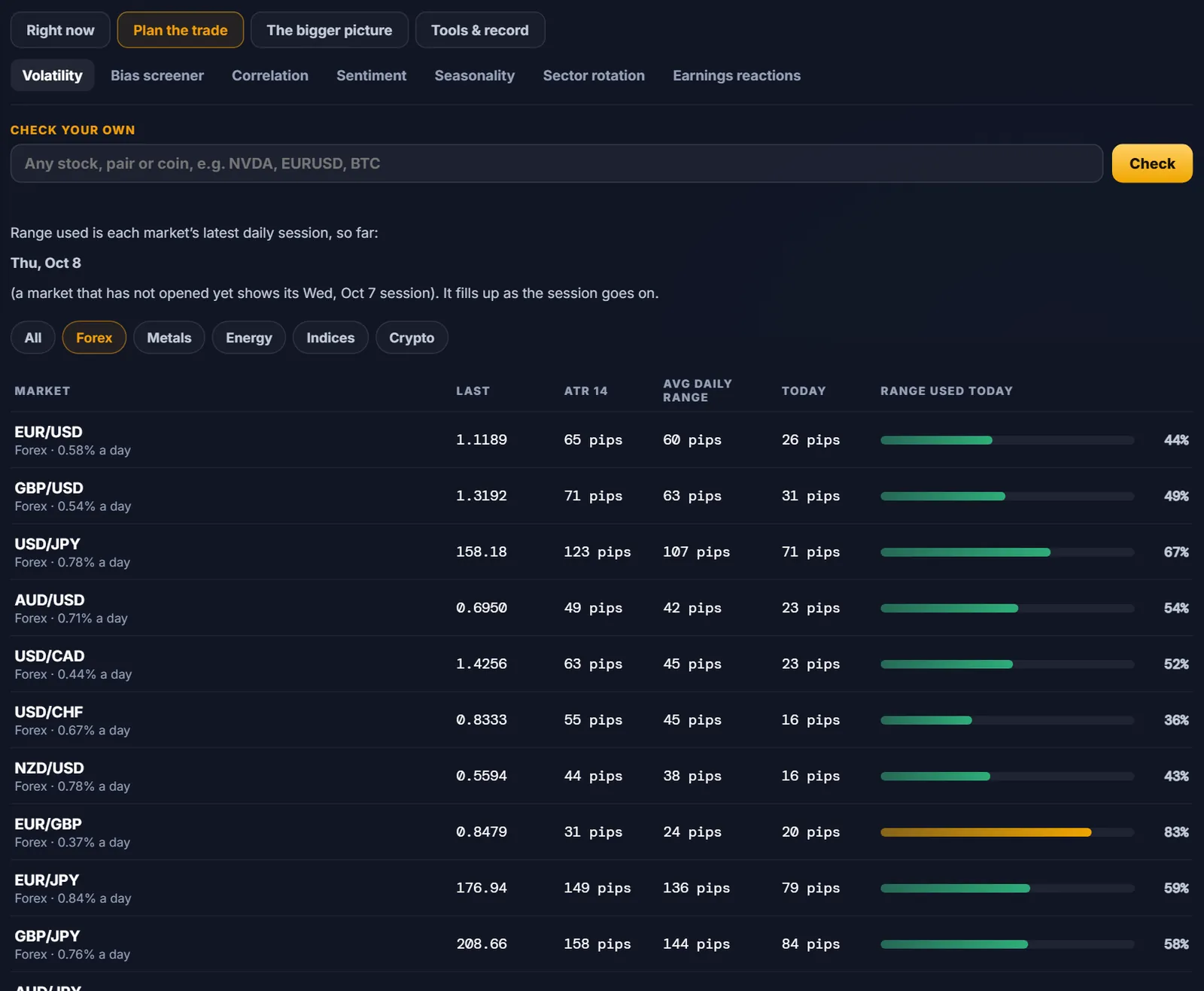
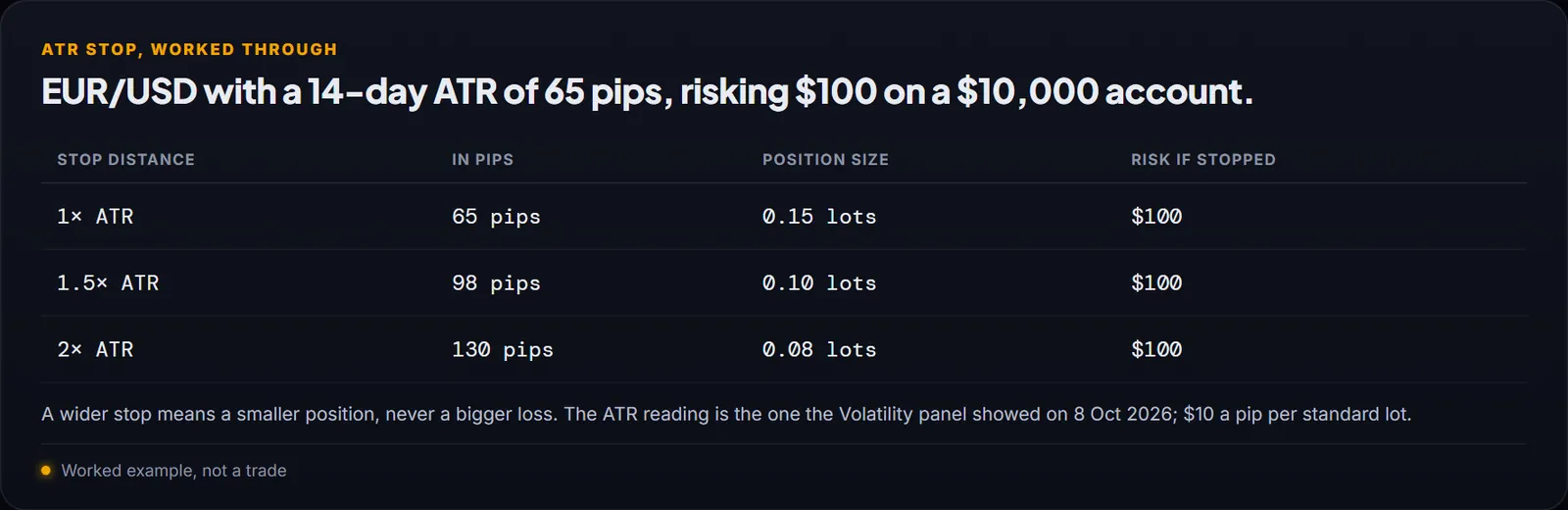
An ATR stop places the stop a multiple of the Average True Range away from the entry, usually 1 to 2 times the 14-day ATR, so normal daily noise cannot reach it. The position is then sized so a full stop costs exactly your planned risk. On 8 Oct 2026 EUR/USD had a 14-day ATR of 65 pips: a 1.5× ATR stop is about 98 pips, which on a $10,000 account risking $100 means 0.10 lots.
What ATR measures
The Average True Range is the average size of a market's daily bar over a lookback, usually 14 days, counting gaps. It says nothing about direction. It tells you how far a market usually travels in a day, which is exactly what a stop needs to know: a stop closer than one ATR sits inside the ordinary wobble and gets hit by noise rather than by the idea being wrong.
The method in three steps
1. Find the structure first. The stop belongs beyond the price that proves the trade wrong, such as the pullback low on a long. ATR does not replace that; it checks it. 2. Check the distance against ATR. If the structural stop is less than about one ATR away, it is too tight for the market and will be hit by noise; push it beyond the next structure or skip the trade. If it is more than two or three ATRs away, the target needs to be far enough to pay for it. 3. Size the position to the distance. Position size = money at risk divided by the stop distance. The stop distance is set by the market; your risk per trade is set by you; the position size is whatever is left.
Worked through on EUR/USD
Using the 65 pip ATR from the panel above and an example $10,000 account risking 1%, or $100: a 1× ATR stop of 65 pips allows 0.15 lots, a 1.5× stop of 98 pips allows 0.10 lots, and a 2× stop of 130 pips allows 0.08 lots. Every row loses the same $100 if the stop is hit. That is the point of the method. The trader who widens the stop without cutting the size has not used ATR, they have just taken a bigger loss.
A real stop on the record
The EUR/USD short from 4 September 2026 had its stop 59 pips above the 1.1636 entry, set just beyond the structure that would have proved the short wrong. It never came close; the trade closed by hand at +1.70R. The losers on the record show the other side: across 111 closes the worst single loss is −1.01R, because each stop was fixed before entry and sized into the position. The stop-loss guide covers where the structural stop goes, and the gold page shows why gold needs a much wider ATR stop than a currency pair.
This week’s setups are already mapped
Every Sunday before the open: analysed swing setups across stocks, forex, gold and crypto with the exact entry, stop and target, an alert when one triggers, the live dashboard and the paid Substack letters.
Get this week’s setups →111 trades · 54 losers shown · +54.5R see the full record →
FAQ
What ATR multiple should I use for a swing trade stop?
Between 1 and 2 times the 14-day ATR is the usual range for daily-chart swing trades, but structure comes first. Put the stop beyond the level that proves the trade wrong, then check it is at least about one ATR away.
Does a wider ATR stop mean more risk?
Not if you size the position to it. Risk is the money lost if the stop is hit, and that is fixed by position size. A wider stop with a smaller position risks the same amount.
Should an ATR stop trail the price?
It can, once a trade is well in profit, but the R is always measured against the original stop. Trailing too early hands winners back to noise.
Where can I see the ATR for a market?
The Volatility panel in the free Markets tab of the Trade Desk shows the 14-day ATR and average daily range for forex, metals, energy, indices and crypto.