Swing trading vs day trading, the honest comparison
The real difference is where the risk lives: day traders pay in screen time, costs and decision fatigue; swing traders pay in overnight and weekend gap risk. For anyone with a job, family or a life at market hours, daily-chart swing trading is the defensible default, not because it is easier to be right, but because its demands fit around a human schedule and its mistakes unfold slowly enough to manage.
The costs nobody itemises
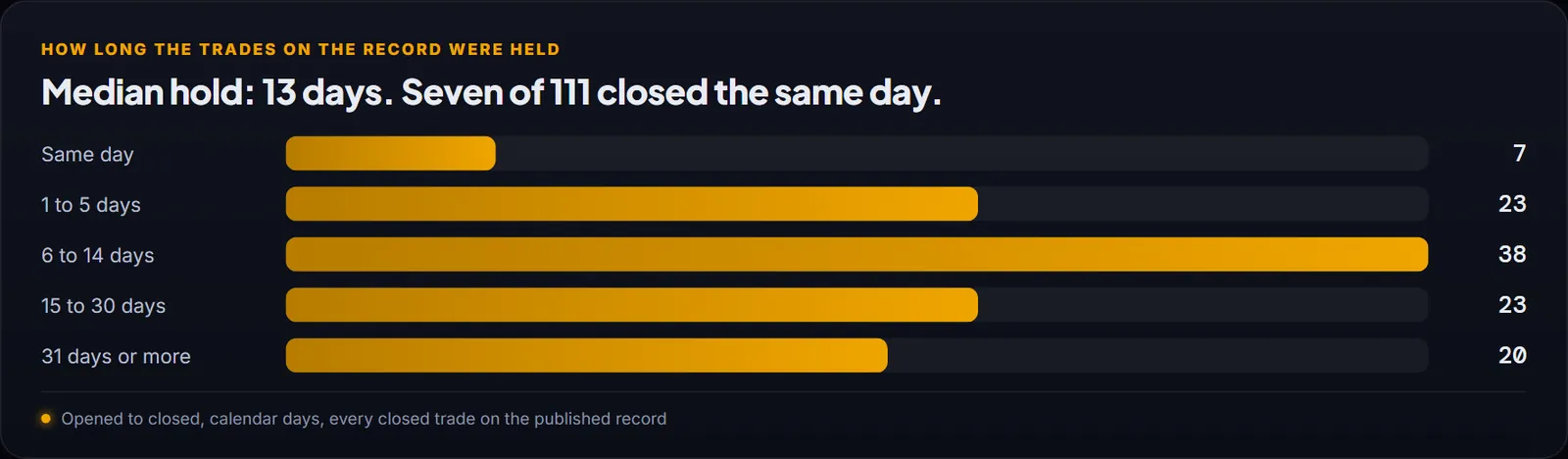
Frequency multiplies friction. A day trader crossing the spread ten times a day pays it two and a half thousand times a year, an edge tax that must be beaten before profit begins. A swing method closing 70–80 trades a year (the desk’s record: 97 in nine months) pays it two orders of magnitude less. Commissions, slippage and data fees follow the same curve.
Decision quality decays with repetition, too. The fiftieth decision of the day is measurably worse than the fifth, and intraday trading is a machine for forcing your worst decisions at your most tired. A weekly plan makes a handful of decisions, rested, with the market closed.
What day trading buys, and what it costs to collect
Flat overnight is a genuine advantage: no gap can hurt you, and an earnings season that terrorises swing books is irrelevant. Feedback is fast, which accelerates learning for the disciplined and account destruction for everyone else. Sample size builds quickly, so a real edge shows up in months instead of years.
The collection cost: presence. Competitive intraday trading is a full-time job against professionals with better tools and lower costs. Doing it part-time from a phone is not a smaller version of the same activity, it is a different activity with the same name and worse odds.
What swing trading concedes
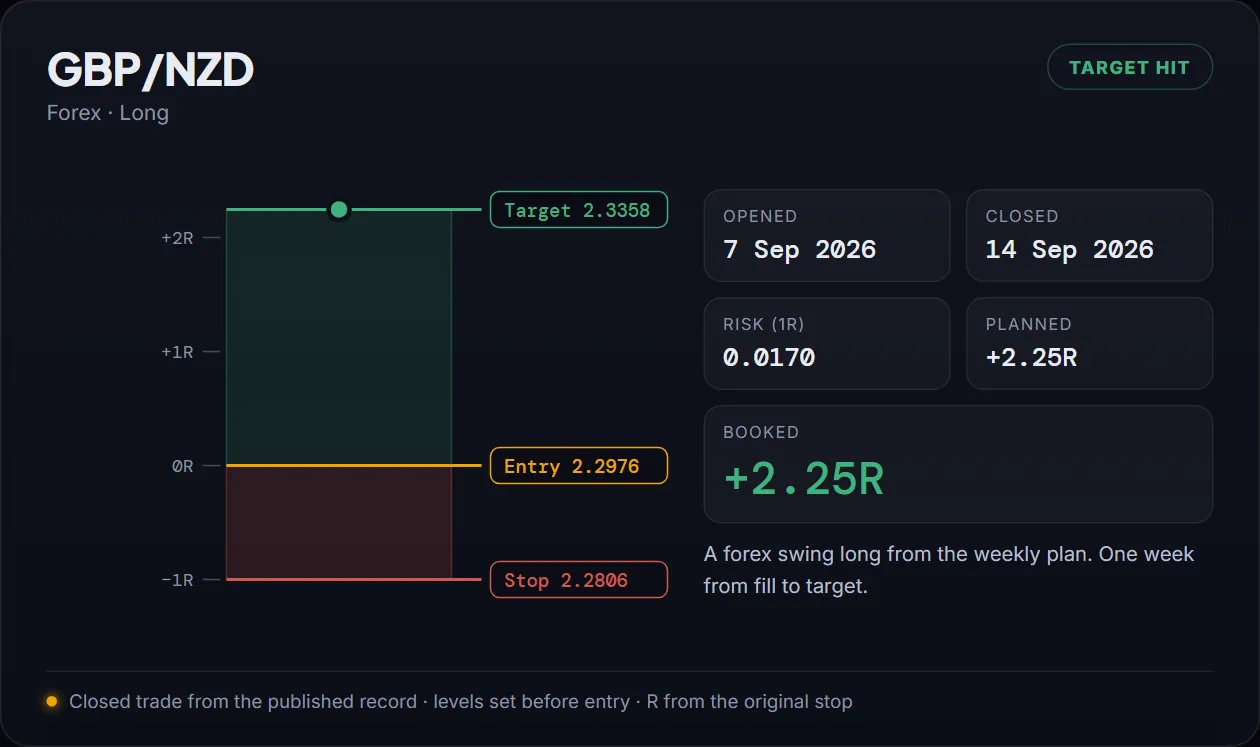
Gaps. A swing book holds through nights, weekends and events, and a stop cannot protect through a gap, the earnings guide is the management manual for the worst of it. Sample size also builds slowly: 111 trades takes most of a year, so proving an edge statistically takes patience the impatient will not spend. And weeks of nothing triggering test discipline in a way constant action never does.
The honest conclusion: day trading suits the few who can make it a profession with professional infrastructure. Swing trading suits everyone whose life happens during market hours, provided they respect the gap risk they are paid to carry. Neither is a shortcut; both reward the boring virtues.
This week’s setups are already mapped
Every Sunday before the open: analysed swing setups across stocks, forex and crypto with the exact entry, stop and target, plus the live dashboard, three letters a week, the TradingView indicator suite and the masterclass library.
Get this week’s setups →111 trades · 54 losers shown · +54.5R see the full record →
FAQ
Which is more profitable?
Neither, inherently. Profit is expectancy × frequency − costs. Day trading has higher frequency and higher costs; swing trading has lower both. A small real edge survives better at low frequency, which is why part-timers should default to swing.
Does the US pattern day trader rule matter?
Less than it did. FINRA Regulatory Notice 26-10 replaces the pattern day trader designation and its $25,000 minimum equity requirement with new intraday margin standards, effective 4 June 2026, and brokers may phase the change in until 20 October 2027, so yours may still apply the old limits until then. Swing trading was never caught by the day-trade count, which is one more way it fits smaller accounts.
Is swing trading safer?
It is slower, which is not the same thing. The per-trade risk is more controllable (fewer, better decisions) but gap risk is real and irreducible. "Safer" belongs to whichever approach you can actually execute with discipline.
Can I do both?
Eventually, with separated accounts, rules and review. Beginners mixing them end up day-trading their swing losers, holding intraday mistakes overnight and cutting weekly winners at lunch. Master one clock first.