Swing trade alerts: what a useful one contains, and how mine work
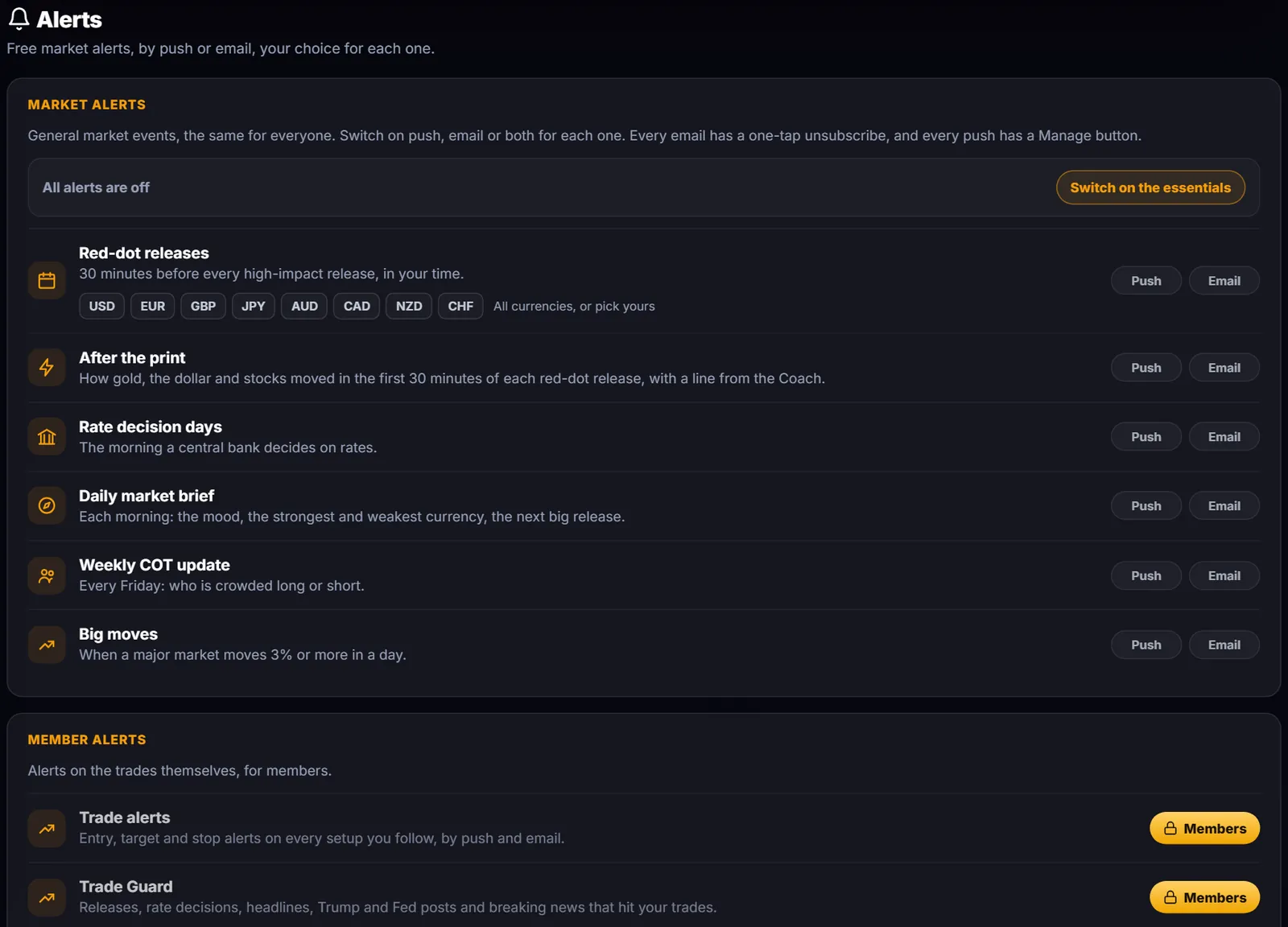
A swing trade alert is only useful if the plan existed before the alert fired. On the Trade Desk every setup is published on Sunday with its entry, stop and target, and the alert fires when price reaches the entry, the target or the stop, by push and by email. You decide on the plan in advance; the alert just tells you the moment has come.
Three alerts, one plan
Most alert services send one message: buy now. A swing trade has three moments that matter, and each needs its own alert. The trigger, when price reaches the published entry. The target, when the trade has done its job. The stop, when the idea was wrong and the loss is booked at the planned size. If a service only tells you about the first one, you are left to improvise the other two, which is where most of the damage happens.
On the Desk the three levels are written down on Sunday, before the week opens. Following a setup arms all three alerts at once. Nothing about the plan changes because the alert fired; it was settled before the market had a say.
What fires an alert, and what does not
An alert fires on a level, never on a feeling. For the swing setups that level is the published entry; for the forex and metals levels it is the price on the spot chart the levels were drawn on. Some setups need a daily close above the level rather than a tap, and the setup says so up front, so a wick through the line on a news spike does not count as a fill.
What never fires an alert: a change of mind mid-week, a headline, or a level moved after the fact. If the stop is moved to break-even after the trade has run, the R is still counted against the original stop, which is why the record cannot be flattered that way.
An alert, start to finish
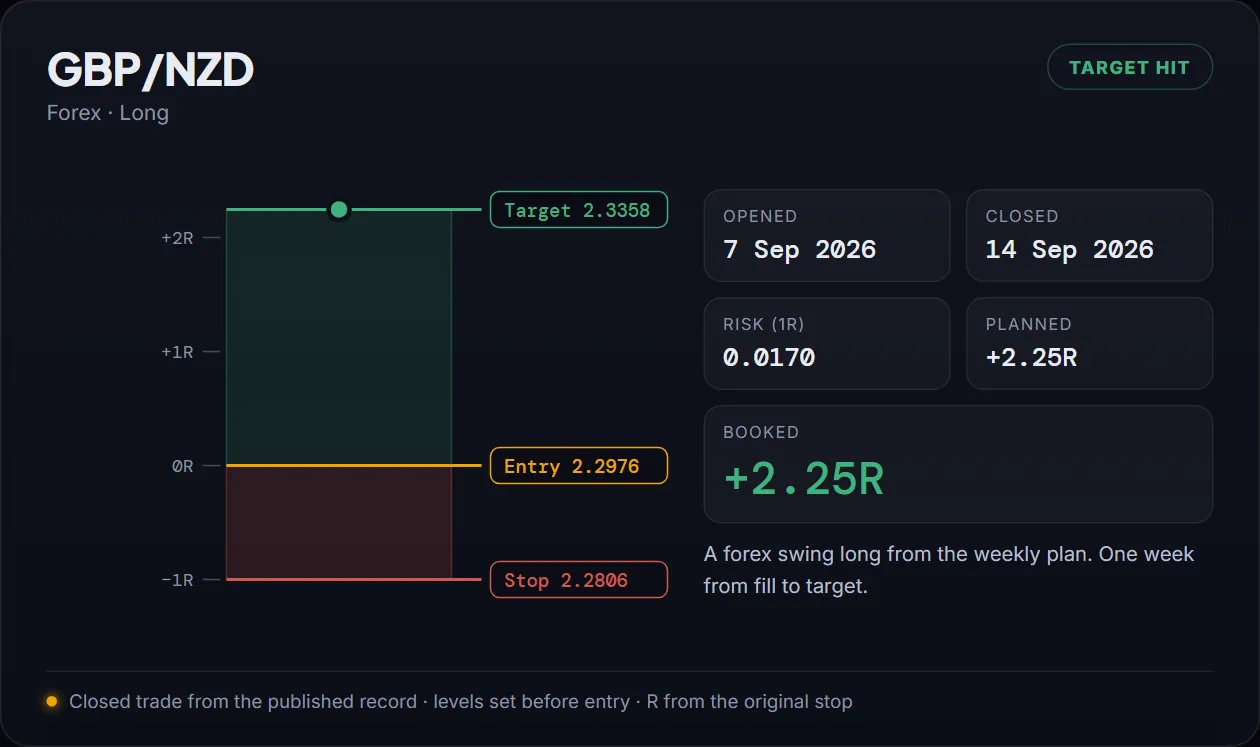
The GBP/NZD long from 7 September 2026 is a clean example. Entry 2.2976, stop 2.2806, target 2.3358, all published before the fill. The trigger alert went out on the fill, nobody had to watch it, and the target alert went out a week later: +2.25R. The losing version looks the same with a different ending: the CORZ squeeze long filled on 23 September and the stop alert fired six days later, a full −1R, booked like every other loser.
How to judge any alert service in five minutes
Ask for one closed alert from last month, losing or winning, and look for four things. Was the stop in the first message? Was the target? Is the result stated in R against that first stop? Is the losing alert in the same list as the winning ones? A service that passes all four is giving you a plan. One that fails them is giving you a tip with a timestamp. The comparison of swing alert services runs those checks on five real services, and trading around a full-time job covers how to live with alerts when you cannot watch a screen.
This week’s setups are already mapped
Every Sunday before the open: analysed swing setups across stocks, forex, gold and crypto with the exact entry, stop and target, an alert when one triggers, the live dashboard and the paid Substack letters.
Get this week’s setups →111 trades · 54 losers shown · +54.5R see the full record →
FAQ
What is a swing trade alert?
A notification that price has reached a level in a swing trade plan: the entry, the target or the stop. A useful one is tied to a plan published before the move, with all three levels, so the alert tells you what to do rather than asking you to decide on the spot.
How are Trade Desk alerts delivered?
By push notification and by email, your choice for each. Trade alerts cover the entry, target and stop of every setup you follow. Market alerts such as high-impact releases and big moves are free.
How many swing trade alerts a week should I expect?
It depends on the market, not a quota. Some levels on a Sunday board never trigger at all. Across the record so far it works out at two or three closes a week, with a median hold of 13 days.
Can I trade the alerts on a prop firm account?
Check your firm first. FunderPro and Fintokei both restrict copying signal providers. Read the guide on swing trading a prop firm challenge, which quotes their rules, before you place a Desk setup on a funded or challenge account.